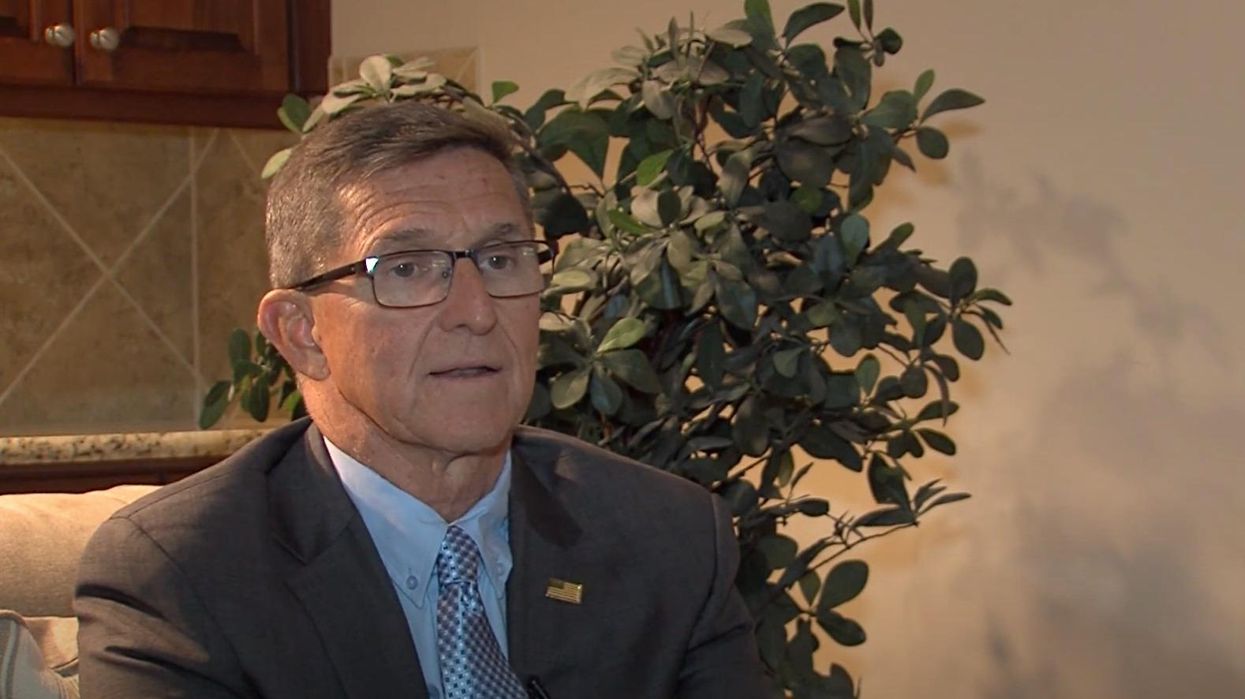
The three men and three women stood with their right arms raised. Behind them the remains of the daylight hued the sky a bluish gray. As a fire danced at their feet, they gazed straight ahead at a camera recording their words. The square-jawed man in the middle, retired Lieutenant General Michael T. Flynn, spoke first. The others, including members of his family, repeated after him.
“I do solemnly swear…”
I…do solemnly swear…
“That I will support and defend…”
That I will support and defend…
“The Constitution of the United States…”
The Constitution of the United States…
The setting for this oath-taking ceremony wasn’t West Point or a U.S. military base. It looked like someone’s backyard, and instead of formal military uniforms, the six participants wore khaki shorts, hoodies, and, in the case of one woman, a white dress decorated with political catchphrases such as “crooked Hillary,” “sleepy Joe,” and “rocket man.” After they had finished reciting the Army’s oath of office, Flynn added a final line: “Where we go one, we go all.”
Where we go one, we go all!
On July 4, 2020, Flynn uploaded this video and the hashtag “#TakeTheOath” to his Twitter account and shared it with his 781,000 followers.
His video quickly went viral and triggered a wave of news coverage. Those seven words Flynn tacked onto the end of the officer’s oath — “Where we go one, we go all” — had first appeared in a mediocre 1990s movie, White Squall, starring Jeff Bridges. More recently, though, the phrase and its acronym, WWG1WGA, had become a rallying cry associated with QAnon, the bizarre conspiracy theory about a supposed cabal of pedophile elites in the Democratic Party and Hollywood who secretly run the world, while harvesting the adrenal glands of children in order to live forever. The Flynn family insisted that the oath was a family tradition having nothing to do with QAnon. (Flynn’s relatives even sued media outlets that claimed a connection.)
In the two years since that moment, what strikes me about that video isn’t the possibility of a QAnon connection, which, to be clear, the Flynn family has unequivocally denied. What stays with me is the pseudo-oath itself and what it catches about this moment in our history.
As you’ll undoubtedly recall, in 2017, Flynn briefly served as President Donald Trump’s first national security adviser, a post he held until it emerged that he had misled the FBI and Vice President Mike Pence about conversations he’d had with the Russian ambassador during the 2016 election campaign. Before that, Flynn had served as a top intelligence officer in Iraq and then Afghanistan, where he worked closely with General Stanley McChrystal who commanded American forces there in 2009 and 2010.
After that perjury scandal drove him out of the Trump administration — don’t cry for Flynn; the president would later pardon him — Flynn returned to civilian life. And yet, to hear him tell it, he never left the battlefield. Where once he had led intelligence officers and trained soldiers in the Middle East, he began speaking about a different kind of battle space. Now, Flynn talks about armies of “digital soldiers” who’ve led an “insurgency” against the political establishment not abroad but right here in America. Flynn has even trademarked the phrase “digital soldiers” and has been listed as a speaker at a Digital Soldiers Conference.
“This was not an election,” he assured the attendees of a Young Americans for Freedom conference. “This was a revolution.”
It’s become common enough to talk about all the ways our wars have “come home.” By this, however, what’s usually meant is the way the veterans of this century’s all-American conflicts continue to grapple with physical disabilities or mental trauma; or perhaps the military-grade vehicles and weaponry the Pentagon has, in these years, handed out to police departments nationwide; or even the way Pentagon budgets continue to soar while lawmakers so often have trimmed federal funding for education, health care, and other safety-net activities.
But after spending the last five years writing a book about conspiracy theories, online cultures, and the real-world harm of digital disinformation, I’ve noticed another way our forever wars have come home. America’s war-making mindset now dominates basic aspects of our domestic political landscape, transforming what once were civil disagreements into a form of partisan or ideological combat. Michael Flynn and his digital soldiers are just symptoms of a country in which members of rival parties or tribes view each other as subhuman, as nothing short of the enemy. And the online spaces where those parties increasingly meet — Facebook, Twitter, YouTube, and other social-media platforms — feel ever less like the proverbial public square and ever more like so many war zones.
In this online battlespace, victory is fleeting and defeat never final, but the casualties are all too real — of fact and truth, memory and reality. I know this because I’ve spent half a decade walking the trenches of those digital forever wars as I pieced together the story of one of their casualties. I was seeking to understand how we got here and whether there’s a way out.
His Name Was Seth Rich
In the early morning hours of July 10, 2016, 27-year-old Seth Rich was walking home from a bar in northwest Washington, D.C. He worked for the Democratic National Committee (DNC), that party’s central organizing hub, and was on the cusp of accepting a job with Hillary Clinton’s campaign and so fulfilling a childhood dream of working on a presidential run. Rich was two blocks from his house when he was shot and killed in what police believe was an attempted armed robbery.
In the months to come, however, his murder would reverberate all too eerily through Washington and across the country. It was hard not to feel grief upon learning that such a bright light had been extinguished so cruelly and suddenly. As it happened, Rich and I even had friends in common. We had played on the same weekend recreational soccer team. In fact, our biographies weren’t all that different — two Midwestern guys, him from Nebraska, me from Michigan, who had moved to Washington after college to try to leave our marks on the world, him in politics and me in journalism. When I learned about his murder, I felt a profound sadness. I also couldn’t shake a there-but-for-the-grace-of-god-go-I feeling that it could’ve been me after a late night out with friends.
Once Rich’s family had laid him to rest in his native Omaha, I expected, like so many others, that the brief frenzy of attention his death had brought would simply vanish. The nosy reporters and TV cameramen would move on to their next story. Rich’s family would receive the space they needed to grieve. They and his friends would gather to remember him on the anniversary of his death or his birthday. They’d tell stories about the head-to-toe Stars-and-Stripes outfits he sometimes wore or his obsession with The West Wing TV show. Perhaps they’d even toast his memory with pints of his favorite beer, Bell’s Two-Hearted Ale.
But that isn’t what happened. Not faintly.
As the police search for Rich’s killer or killers dragged on, a howling mob began to fill the void. Wild speculation and fantastical theories about his death started to appear online with viral hashtags — #IAmSethRich, #HisNameWasSethRich, #SethRich — while memes surfaced on political message boards leading, eventually, to elaborate conspiracy theories that would spread globally. Those theories initially originated on the far left, with claims (lacking a shred of evidence) that Rich had been killed by the Clinton family for trying to blow the whistle on or expose wrongdoing by the DNC.
And then, like a virus jumping from host to host, a new version of that conspiracy theory took a firm hold on the far right, its promoters insisting — again, without a scintilla of evidence — that Rich, not Russian-affiliated hackers (as concluded by cybersecurity experts, federal law enforcement, and the U.S. intelligence community), had hacked the DNC and stolen tens of thousands of its emails and other records, later providing those pilfered documents to the radical transparency group WikiLeaks. After WikiLeaks published those stolen DNC documents at the height of the 2016 campaign, its founder Julian Assange, in an apparent attempt to obfuscate the source of those records, dangled Rich’s name in a way that suggested he, not Russia, might have been the source.
In the hands of online commenters, political operatives like Republican dirty trickster Roger Stone, crowdfunded MAGA influencers, and primetime Fox News hosts including Sean Hannity, the story of Seth Rich’s life and death would then be warped into something altogether different: a foundational conspiracy theory for the twenty-first century.
Casualty of a Culture War
My book about the Rich saga, A Death on W Street: The Murder of Seth Rich and the Age of Conspiracy, began when I asked myself a simple question: How could that young man’s death have grown into something so vast and hideous? And what did it say about this increasingly strange country, our ever more perverse politics, and what may lie in our future? Put another way, I wanted to know how a regular guy, someone not so different from me, could become the fixation of millions, his name and face strewn across the Internet, his life story exploited and contorted until it became unrecognizable to those who knew him.
With time, I came to see Rich’s life and death as a genuine, if grim, parable for twenty-first-century America — a “skeleton key” potentially capable of unlocking so many doors leading toward a clearer understanding of how we ended up here. By here, of course, I mean a nation millions of whose citizens believe that the last election was stolen or fraudulent, that Covid vaccines can’t be trusted, and that only Donald Trump can defeat the secret cabal of pedophile elites and “deep state” operatives who supposedly pull all the strings in America.
As I write in my new book, we now live in
“a time when it feels like truth is whatever the loudest and most extreme voices say it is, not where the evidence leads, what the data show, or what the facts reveal. A moment when people can say whatever they want about anyone else, dead or alive, famous or obscure, and in the wrong hands, that information can take on a life of its own.”
But it wasn’t until I rewatched Michael Flynn’s 2020 #TakeTheOath video that I saw the connection between America’s disastrous forever wars and its fractured political system at home.
A vicious conspiracy theory such as QAnon or Pizzagate, a dark and disturbing fiction about a supposed child-trafficking operation run by Democratic Party leaders out of a D.C. pizzeria, does more than advance some fantastical and wildly implausible claim about a group of people. It dehumanizes them. By accusing someone of the most evil acts imaginable, you rob him or her of humanity and dignity. In the simplest yet most warlike terms imaginable, you cast them as the enemy, as someone to be defeated — if not with real weapons, then with cruel tweets and deceptive videos.
And of course, there’s no shortage of evidence that digital soldiering can lead to actual violence. In December 2016, a North Carolina man who had watched Pizzagate videos online drove to that D.C. pizza joint targeted by conspiracy theories, walked inside armed with an AR-15 rifle, and fired three shots into a closet. He believed himself on a mission to save the children. Instead, he received a four-year prison sentence. And it’s only gotten worse since. The January 6, 2021, insurrection might have been the starkest evidence that Internet-fueled fantasies — in that case, of a stolen presidential election — could have grave consequences in the actual world.
The casualties of such conspiracy theories are all too real. Four Trump supporters died on January 6th during the insurrection, while multiple police officers at the Capitol that day would die in the weeks that followed. And even though Seth Rich was killed by an unknown assailant — the investigation into his homicide remains ongoing — you could say that he, too, was a casualty of our online wars. His name and memory were twisted and weaponized into something wholly unrecognizable, then harnessed for causes he would never have endorsed by people he would have been unlikely to agree with. Seth’s mother, Mary, once described to an interviewer what all this felt like to her: “Your son is murdered again and this time it’s worse than the first time. We lost his body the first time and the second time we lost his soul.”
Lay Down Your Digital Arms
What, if anything, can be done to demobilize those armies of digital soldiers? What could convince people to lay down their “arms” and treat so many of the rest of us with humanity, even if they disagreed with us?
I’ve thought a lot about such questions in the past several years. The spread of online disinformation has been deemed a crisis by experts and watchdogs — in 2020, former president Barack Obama called it “the single biggest threat to our democracy” — but what to do about it is an especially thorny question in a country with strong protections for free speech.
There are any number of ideas floating around about how to combat disinformation and conspiracy theories, while putting facts and truth back at the heart of our political system. Those include forcing Facebook, Twitter, and YouTube to rework their algorithms to deemphasize hyperbolic content and using “prebunks” before such deceptive information appears to inoculate people against it rather than having to debunk it later.
I have a few ideas of my own after spending five years on a book significantly about the conspiracy theories spreading ever more widely and wildly in our world. But let me here just offer a couple of modest suggestions for each of us in our daily lives.
The first is simple enough: Think before you post. (Or tweet, or TikTok, or whatever.) Disinformation spreads because people — and occasionally bots — spread it, sometimes on purpose, but often enough remarkably unwittingly. Before you retweet that spicy takedown tweet or share a friend’s fiery Facebook post, read it again and think twice. Check that it’s real. And take a moment to ponder whether adding your voice to a growing din of outrage is really what this world of ours needs right now.
The second suggestion is something of a throwback: Put down your devices. Talk to a neighbor. Talk to a stranger. In person. It’s a lot harder to demonize or dehumanize someone you disagree with if you meet them face to face. It’s an old-school solution to a decidedly postmodern problem. Still, it may, in the end, be the only reasonable way to defuse this fraught political moment — one where, in a distinctly over-armed country, all too many Americans are dreaming about a future civil war — and find our way back to something approaching common ground.
Copyright 2022 Andy Kroll
Andy Kroll is an investigative journalist with ProPublica based in Washington, D.C. His just-published book is A Death on W Street: The Murder of Seth Rich and the Age of Conspiracy. Follow him on Twitter at @AndyKroll and on Facebook.
Reprinted with permission from TomDispatch